
Law and Democracy: The Profession at a Crossroads

For most of the modern era, law and politics have worked because each stayed in its own lane. Courts decide, legislatures debate, lawyers advocate, and each keeps the others honest. That balance is now under real strain, not from one dramatic event, but from a slow, deliberate erosion happening around the world. The numbers back this up. According to the World Justice Project, 68% of countries saw their rule of law scores decline in 2025, up from 57% the year before. The decline is concentrated exactly where law and politics meet: oversight of executive power weakened in 61% of countries. As one expert put it, when government isn’t held to clear, equally applied rules, the confidence needed for long-term stability collapses. What makes this moment different is the method. Independent judiciaries today are rarely dismantled by coup or revolution. They’re dismantled through law itself, as leaders invoke reform or efficiency to justify stripping courts of their power to check government. Common tactics include taking over judicial councils, cutting court resources, and going after lawyers directly.That last part matters. The independence of lawyers, their ability to represent unpopular clients and challenge government without fear of retaliation, is treated internationally as a cornerstone of the rule of law itself. In Iran, defense lawyers have faced what the International Bar Association calls a systematic assault. In China, lawyers taking on sensitive clients continue to face license revocations. In the United States, executive orders this year targeted specific law firms for representing the administration’s political opponents, prompting an amicus brief from more than two dozen bar associations. These U.S. measures are still working through litigation, and reasonable people disagree on where legitimate accountability ends and improper interference begins. That disagreement itself illustrates the broader tension. It isn’t all decline, though. In Brazil, a proposed amendment that would have limited judicial oversight of lawmakers was struck down after mass protests. The European Court of Justice has taken an assertive stance this year, ruling against member states that violated EU legal standards. For lawyers, all this raises the stakes of ordinary work. Legal practice has always been part technical craft, part public trust. When institutions are stable, that public dimension fades into the background. When they’re contested, it comes back to the front, whether lawyers seek that role or not. The core point isn’t really up for debate, even if the politics around individual cases are: an independent bar and an independent judiciary aren’t optional features of democracy. They’re load-bearing ones. When either weakens, the ability of ordinary people to hold power accountable weakens with it. SourcesWorld Justice Project, Rule of Law Index 2025, via ABA Business Law TodayFrontiers in Political Science, “Courts in the storm,” 2026ConstitutionNet, “A Year in Constitution-Building”International Bar AssociationNew York City Bar AssociationEuropean Commission, 2026 Rule of Law Report coverage
Law and Democracy: What It Means for Nigeria

Nigeria’s democracy runs on a simple idea: no one, not even the president or a state governor, stands above the law. That idea is tested constantly, and this year has given Nigerians plenty of fresh examples of both the strain and the resilience of that system. Judicial independence has been a stated priority since President Tinubu took office in 2023, when the first bill he signed was aimed at judicial reform, promising financial independence and integrity for the judiciary. But the gap between that promise and daily reality remains wide. Legal commentators keep pointing to the same root problem: state judiciaries still depend on governors for funding, which leaves judges vulnerable to pressure from the very officials whose actions they may need to rule on. Until courts control their own budgets, true independence stays incomplete. The Rivers State crisis put this tension on full display. When the president declared emergency rule and suspended the state’s elected governor and lawmakers, replacing them with an unelected administrator, the case eventually reached the Supreme Court. The ruling itself became controversial: some legal scholars argued the court missed a chance to clearly define the limits of presidential emergency power, while others accused it of overstepping into a political dispute by directing that federal allocations to the state be withheld. Even commentators who welcomed the outcome acknowledged that by the time the court ruled, the emergency had already run its course and most of the political facts on the ground had changed. That timing question matters as much as the ruling itself. A judiciary that acts too late to affect the outcome sends its own message about where real power sits.None of this means the courts are powerless. In a landmark ruling, the Supreme Court affirmed the financial autonomy of Nigeria’s 774 local governments, recognizing them as a genuine third tier of government rather than an appendage of state governments. That judgment showed a court willing to use its authority to rebalance power in favor of constitutional structure, not against it. For lawyers and everyday citizens alike, the lesson is the same one playing out elsewhere in the world: a judiciary is only as independent as its funding, its appointments process, and its willingness to rule against powerful interests when the law demands it. The Nigerian Bar Association and legal scholars continue to push for full financial autonomy for state judiciaries and merit-based appointment of judges, arguing that political influence and nepotism in judicial appointments undermine the very foundation the constitution was built to protect.Nigeria’s courts remain, as they are often described, the last hope of the common man. Whether that description holds depends less on grand pronouncements and more on the unglamorous work of securing judicial budgets, insulating appointments from political patronage, and making sure rulings arrive while they can still make a difference. SourcesVanguard News, “Tinubu’s Anniversary: Judiciary/Rule of Law – No Excuses to Fail, But…”The Cable, “Rivers Emergency, Supreme Court Ruling and Limits of Presidential Power”Daily Trust, “Supreme Court Judgement Did Not Favour the Executive — Yadudu”ConstitutionNet, “Nigeria’s Supreme Court Protects Autonomy of Local Governments”Nigerian Observer, “Lawyer Advocates Limiting Supreme Court Jurisdiction to Improve Judicial Efficiency”Daily Trust, “States’ Judiciary, Legislature Deserve Financial Autonomy”
Nigeria’s 2027 Presidential Election and the Role of the Tribunal

Nigeria’s next presidential election is now set for January 16, 2027, moved up from the original February date after a new Electoral Act came into effect this year. It will be the first presidential poll held in January since 1999, and the shift is already shaping how campaigns, party primaries, and eventually court challenges will unfold.INEC says it wants to test-run the process before Nigerians vote, including a possible mock presidential election and a full audit of its election technology, an effort to avoid a repeat of the disputes that trailed the 2023 election, especially around the BVAS card readers and the IReV result portal. That history matters, because whatever happens on election day rarely ends there. In Nigeria’s system, the real test of legitimacy often plays out afterward, in the tribunals. The Electoral Act 2026 changes some of the ground rules for that process. For the first time, the law gives full legal backing to the IReV portal and makes electronic transmission of polling unit results mandatory rather than discretionary. Under the old law, the Supreme Court had treated IReV as just a public viewing tool, not part of the official collation process, which weakened its value as evidence in court. Now, a presiding officer’s failure to transmit results electronically counts as a breach of statutory duty and can be used directly to challenge a result in a tribunal. That’s a meaningful shift. In 2023, much of the tribunal battle over the presidential result turned on arguments about whether electronic transmission was even a legal requirement. The courts ultimately said it wasn’t, and both opposition candidates lost their petitions. With the new Act, that argument is largely settled going into 2027, which should sharpen the issues tribunals actually have to decide. Still, structural challenges remain. Legal analysts have pointed out that the compressed timeline between party primaries, candidate nominations, and election day leaves petitioners with limited time to gather evidence and produce agents as witnesses from every contested polling unit, a heavy burden given how little time the law allows to prove a case. Petitioners are expected to move fast, while courts are expected to rule fast, and neither side gets much room for error. The tribunal system exists precisely because Nigeria learned, over repeated election cycles, that ballots alone don’t settle disputes about legitimacy. Someone has to referee claims of rigging, wrongful exclusion, and technical non-compliance, and do it within a fixed window so the country isn’t left without a settled outcome for months on end. Whether the tribunals succeed in that role in 2027 will depend on the same things that have determined outcomes before: how strictly the new transmission rules are enforced on the ground, how much real evidence petitioners can gather in the time allowed, and whether judges apply the law consistently regardless of who is asking. For a country where past presidential petitions have ended in dismissal more often than reversal, the coming cycle is a genuine test of whether the legal reforms actually change outcomes, or just change the arguments lawyers make on the way to the same result. SourcesVanguard News, “2027: INEC to Conduct Mock Presidential Poll”AllAfrica, “Nigeria: INEC Reschedules 2027 General Election, Releases New Election Timetable”ThisDay, “Electoral Act 2026: The Pros and Cons”Dawn Commission, “The Electoral Act 2026” (legal analysis)PM News Nigeria / Legal Nigeria, “Key Amendment in 2026 Electoral Act You Need to Know”Policy and Legal Advocacy Centre (PLAC), “The 2027 Electoral Calendar: Factsheet”
The Importance of Father Figures at the Bar: The Case of Aare Afe Babalola
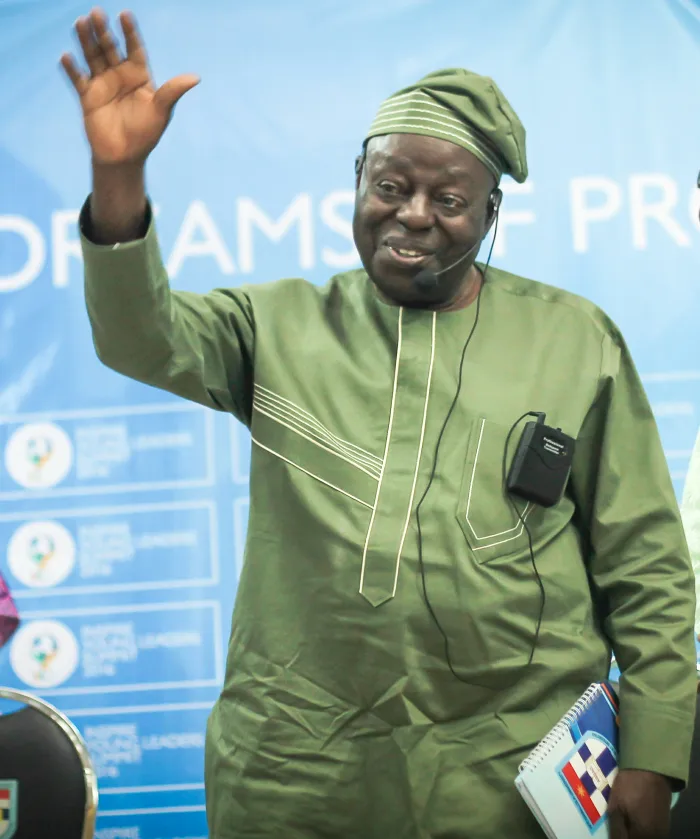
Every profession has its own idea of what a father figure looks like. At the Nigerian Bar, few names come up as often, or as reverently, as Aare Afe Emmanuel Babalola. Called to the Bar at Lincoln’s Inn in 1963 and made a Senior Advocate of Nigeria in 1987, Babalola built more than a legal career. He built a pipeline. His chambers, Emmanuel Chambers, is credited with producing more Senior Advocates of Nigeria than any other in the country, more than twenty-three by recent count. Two of his protégés went on to serve as Attorney General and Minister of Justice of the Federation. Numbers like that don’t happen by accident. They happen because someone made a deliberate choice, case after case and junior after junior, to treat training the next generation as part of the job rather than a distraction from it. What makes Babalola’s story a useful case study isn’t just the scale of what he built, it’s the shape of it. He was offered the position of Attorney General of Nigeria and turned it down, choosing instead to stay in practice and keep shaping the profession through advocacy and mentorship. That’s a telling decision. Political office offers status. Mentorship offers legacy. Babalola clearly understood the difference, and bet on the one that would outlast him. That bet paid off in a form few lawyers ever achieve: an institution. In 2009, at the age of eighty, he founded Afe Babalola University in Ado-Ekiti, entirely from personal resources. Sixteen years later, it’s regularly ranked among Nigeria’s best universities and counted among the leading institutions in Africa, with a law college that has repeatedly been rated the best in the country. The instinct behind it is the same one that filled his chambers with future SANs: if you have knowledge and means, the job isn’t finished until you’ve built something that keeps producing capable people after you’re gone. Colleagues who have spent time with him describe the same thing over and over: a man in his nineties still in his office late at night working alongside younger staff, still personally engaged in the institutions he built, still expecting excellence and still willing to demonstrate it himself rather than just demand it. That’s arguably the real definition of a father figure at the Bar. Not someone who hands down favors, but someone whose own discipline sets the standard juniors feel obligated to meet. There’s a lesson here that travels well beyond Nigeria, to any common law jurisdiction where a bar’s culture depends on senior practitioners choosing to invest in juniors rather than simply compete with them. Legal skill can be taught in a classroom. Judgment, discipline, and a sense of duty to the profession’s future are usually only caught, by watching someone senior live them out. Babalola’s chambers and his university are, in a sense, the same project pursued through two different institutions: take what you were given, and make sure more people inherit it than you started with. SourcesThe Nation, “Afe Babalola: From Farmboy to Global Icon”Daily Trust, “Alumni Celebrates Afe Babalola ‘Inspiring’ Life”Mike Ozekhome’s Chambers, “Aare Afe Babalola Day: The Legacy of a Lifetime”Office of the Vice Chancellor, ABUAD, “ABUAD at 16: Afe Babalola Reaffirms Vision”The Nation, “CIBN Hails Afe Babalola for Establishing ABUAD”